
Makaton: Frequently Asked Questions
Makaton is a communication programme that uses signs, symbols, and speech to make communication accessible. It helps people understand, express themselves, and connect with the world around them.
No — Makaton is different from BSL.
BSL is a full language in its own right with its own grammar and syntax. Makaton uses speech, signs, and symbols together to support understanding and communication. Please read my blog for more information 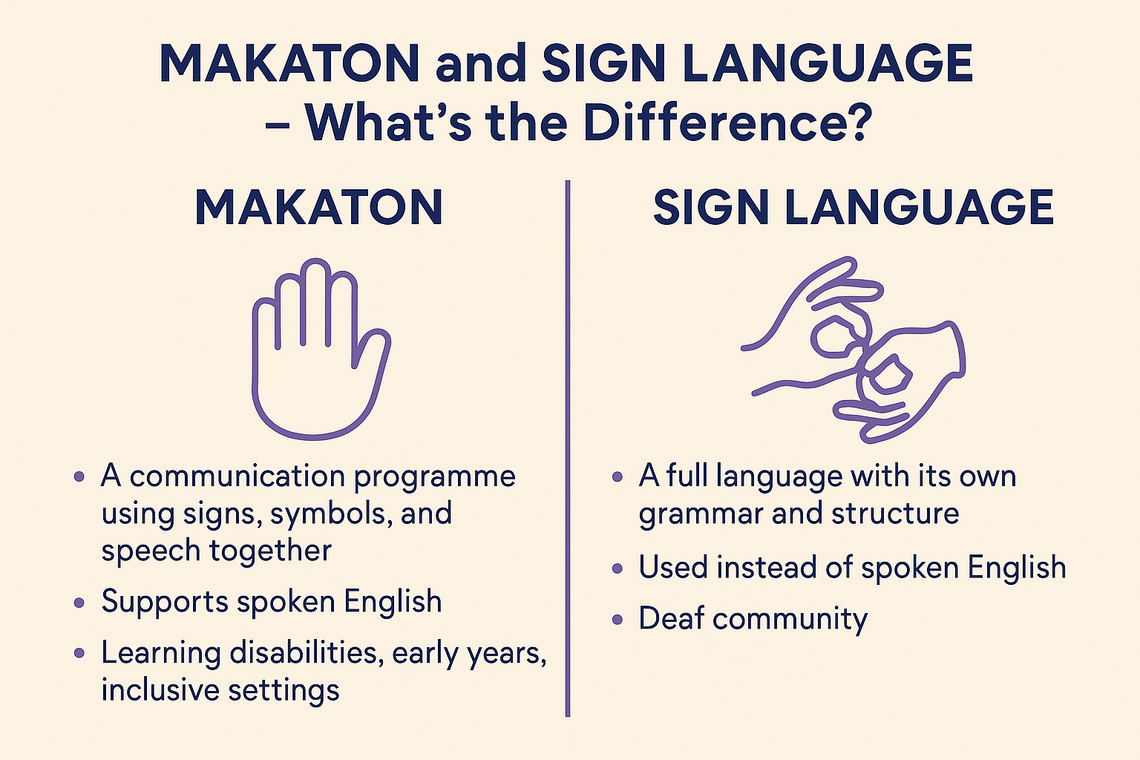
Makaton can help anyone who finds communication difficult. It’s widely used with children and adults with learning disabilities, autism, Down’s syndrome, and other speech or language challenges. It’s also a brilliant tool for family members, carers, teachers, and support workers.
No. Makaton can be used by people of all ages.
Although many people first come across Makaton in early years settings, schools or children's television, teenagers and adults use Makaton too. Some people may use it for a short period, while for others signs and/or symbols remain an important part of their communication throughout their lives.
Communication doesn't have an age limit, and neither does Makaton.
You can find out more on our Who Uses Makaton? page.
No. Using Makaton does not stop someone from developing or using speech.
Makaton is designed to support speech and communication, with signs and symbols used alongside spoken language. For someone who finds speech difficult, a sign or symbol can give them another way to communicate while reducing the pressure of relying on speech alone.
If speech develops, Makaton doesn't have to disappear. Some people naturally use fewer signs as their speech becomes clearer, while others continue to find signs and symbols useful for understanding, expressing themselves or communicating when words are difficult.
The aim isn't to replace speech - it's to make sure someone has a way to communicate.
No. Makaton uses signs, symbols and speech, but that doesn't mean every person needs to use all three in the same way.
Some people may mainly use signs alongside speech, while others find symbols particularly helpful for understanding information, making choices or expressing themselves. Some people use both signs and symbols, and the balance may change depending on the situation.
Symbols can also provide a lasting visual reference, which can be useful when someone needs more time to process information or wants to return to it later.
The important thing is to use the parts of Makaton that support the individual's communication needs. There is no one-size-fits-all approach.
Yes. Makaton can be used alongside many other ways of communicating.
Someone might use Makaton signs and symbols alongside speech, photographs, objects, written words, communication books or an AAC device. Different methods can complement each other, giving someone more ways to understand information and express themselves.
Communication is individual, and people don't need to rely on just one method. The aim is to give someone the tools and opportunities they need to communicate as effectively as possible.
Makaton is based on concepts rather than individual words. In current Makaton, different concepts are represented by their own signs and symbols, although the same concept may sometimes be expressed using different spoken words.
For example, the Makaton concept HELLO might be expressed in speech as “hello”, “hi”, “hiya” or “hey”. The words are different, but the underlying concept is the same.
You may come across older Makaton resources where some concepts that are now separate were grouped together. The Makaton vocabulary has developed and been revised over time. For example, in older Makaton materials, LOOK and SEE were represented together, whereas they are separate concepts in current Makaton.
This historical difference may explain some of the misconceptions about Makaton that still exist today. When describing current Makaton, it's important to use up-to-date vocabulary and resources.
Makaton helps create inclusive environments where everyone feels understood. In schools, it can support learning, behaviour, and friendships. In workplaces or community groups, it helps adults with learning disabilities take part more fully and confidently
Not at all! Makaton is designed for beginners and can be used straight away. Even learning a handful of signs can make a big difference to everyday communication.
No. When using Makaton, we usually sign the key words in a sentence while speaking naturally.
For example, in the sentence “Would you like a drink?” you might sign WANT and DRINK, while saying the whole sentence.
Choosing the important words helps to emphasise the meaning of what is being said without making communication unnecessarily complicated.
As someone's understanding and communication develop, the number and type of signs used can change too.
You can find out more about signs, symbols and speech on our How Makaton Works page.
Makaton is designed to provide a consistent, standardised approach to communication, so Makaton signs don't have regional variations in the same way that British Sign Language (BSL) does.
Makaton signs are based on signs from BSL, where regional variations are a natural part of the language. For Makaton, particular signs are selected and standardised so that people learning and using the programme have a consistent vocabulary.
You may occasionally see people using a sign differently because of previous learning, local signing traditions or an individual's own way of communicating. This doesn't mean there are official regional versions of Makaton signs.
Learning through licensed Makaton training and using current Makaton resources helps ensure that you are learning the recognised signs.
Makaton Training
If you're new to Makaton, Level 1 is a great place to start if you want to develop a broad foundation in using Makaton signs and symbols.
However, Level 1 isn't the only starting point. Makaton offers a range of licensed workshops designed for different people, roles and settings, so another workshop may be more appropriate for you.
For example, there are workshops specifically for families, early years settings, healthcare teams and other organisations, as well as introductory and specialist training.
If you're not sure which workshop best meets your needs, get in touch and I'll be happy to help you choose the most appropriate Makaton training.
There isn’t a single answer, because it depends on how you want to use Makaton. There are several different training workshops available:
-
Core Vocabulary – To learn the essential Makaton Core Vocabulary, you’ll need to complete four workshops (the equivalent of four full days).
-
Safeguarding – You can expand your Core Vocabulary by attending a two-day Makaton Approaches to Safeguarding workshop.
-
Makaton for… – These workplace-focused sessions provide an introduction to Makaton with vocabulary specific to your setting. They can usually be completed in just half a day.
-
Using Makaton with Singing – A half-day workshop for learning Makaton signs through early years songs.
-
Know and Grow – A one-day workshop that introduces Makaton for Christian worship.
So, whether you’re looking for a short introduction or a full Core Vocabulary programme, there’s a training pathway to suit your needs.
All licensed Makaton workshops follow a nationally approved programme developed by The Makaton Charity, so the course content cannot be changed.
However, we're happy to help you choose the workshop that best meets the needs of your organisation. Whether you work in education, healthcare, social care, the voluntary sector or another setting, we can advise on the most appropriate workshop and discuss whether face-to-face or online training would work best for your team.
If you're unsure where to start, simply get in touch and we'll be happy to help
I provide Makaton training in Bristol, South Glos and surrounding areas and online. If you’re looking for face to face Makaton workshops for parents, carers, or professionals in the South West, I can deliver tailored sessions to suit your needs. I also deliver Makaton training online anywhere in the UK, so you can join from the comfort of your own home, school, or workplace
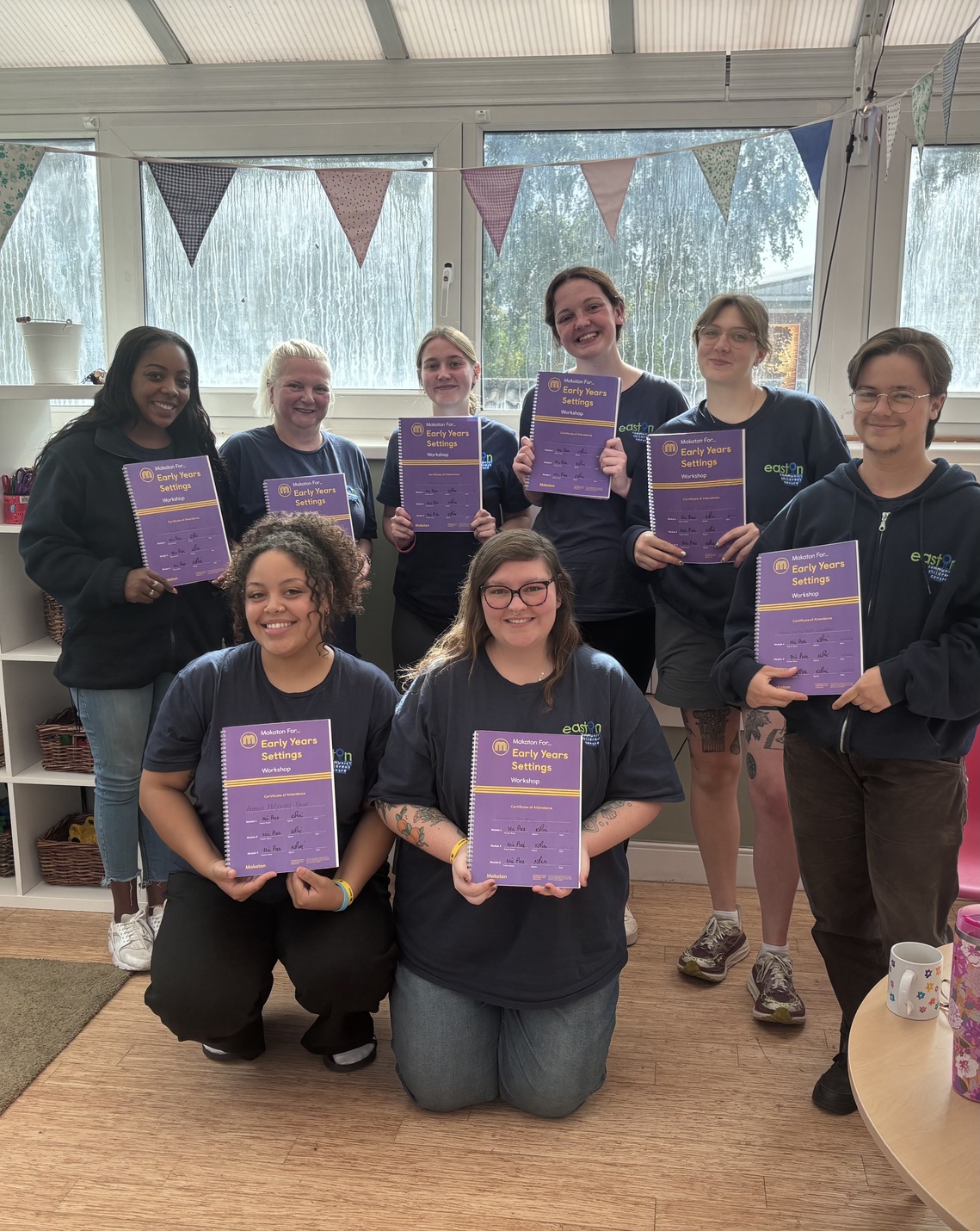
Safeguarding or Using Makaton with Singing will receive an official certificate of attendance from The Makaton Charity.
We recommend keeping your certificate somewhere safe, as you may need to provide evidence of previous training if you choose to progress to further licensed Makaton workshops.
If you need a replacement certificate, please get in touch. Replacement certificates may be available, although an administration fee may apply.
Yes. We provide licensed Makaton workshops for organisations across Bristol, South Gloucestershire and the surrounding areas, as well as online throughout the UK.
We regularly work with schools, nurseries, healthcare teams, care providers, charities, churches, visitor attractions, local authorities and businesses. Training can be delivered at your venue or online and tailored to suit your team, service and the people you support.
Whether you're looking for a taster session, a full licensed Makaton course or specialist training (Makaton For...) , we'll work with you to find the most suitable option.
Get in touch to discuss your organisation's requirements or request a no-obligation quote.
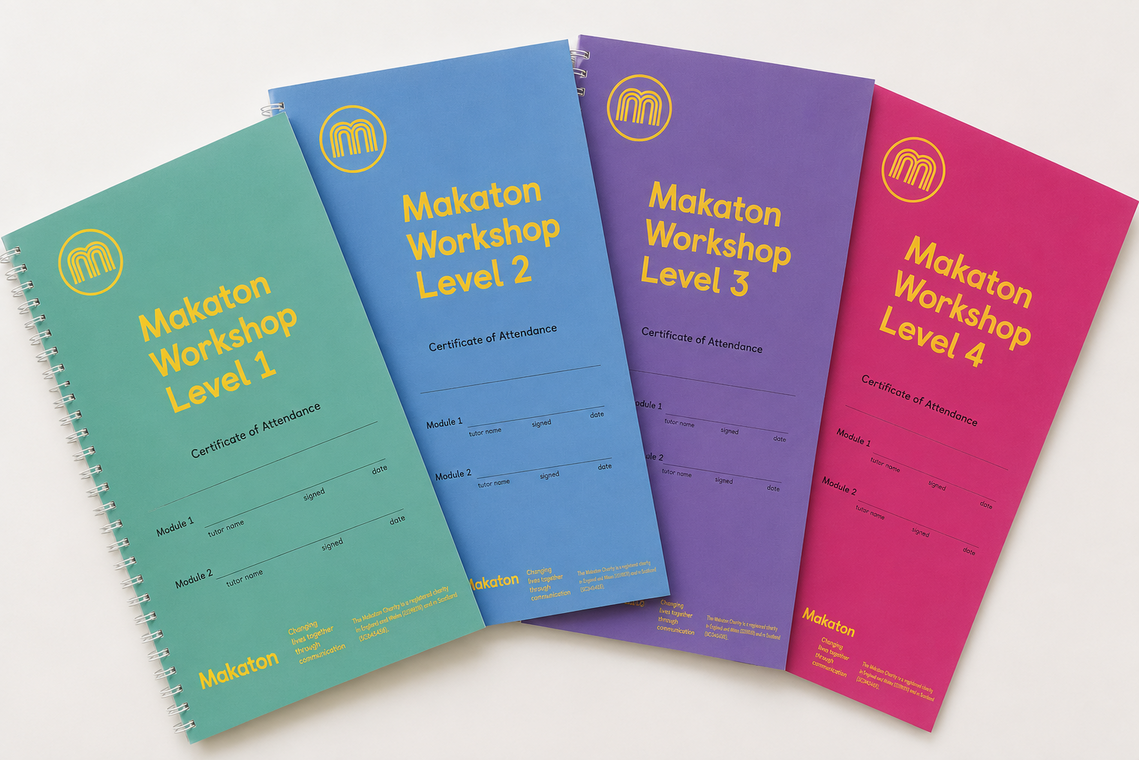
Yes. Makaton Levels 1–4 are designed to be completed in order, with each workshop building on the vocabulary, signs, symbols and knowledge covered in the previous Level.
You start with Level 1, followed by Levels 2, 3 and 4. You will need to have completed the previous Level before moving on to the next one.
You don't necessarily need to complete all four Levels, though. How far you progress will depend on your own needs and how you use Makaton.
Yes! I offer online Makaton training sessions that are interactive, fun, and easy to join from home. Whether you’re a parent, carer, or professional, you can learn Makaton through live online workshops.
No. Completing a Makaton workshop does not give you a formal qualification in Makaton.
When you successfully complete a licensed Makaton workshop, you will receive a certificate of attendance from The Makaton Charity confirming the training you have completed.
This is evidence of your Makaton training, but it does not qualify you to teach Makaton to others or describe yourself as a Makaton Tutor. Becoming a licensed Makaton Tutor involves completing a separate Tutor Training pathway with The Makaton Charity.
You may come across Makaton signs in videos and on social media, and these can be useful for practising or refreshing signs you have already learned. However, watching videos isn't the same as completing licensed Makaton training. There is also a lot of Makaton-related content online, and unfortunately it isn't always accurate. If you're using videos to support your learning, look for content created by licensed Makaton Tutors, The Makaton Charity or other trusted Makaton sources.
Makaton workshops are interactive and include much more than learning individual signs. You'll learn about the Makaton Communication Programme, how and why signs and symbols are used, and have opportunities to practise and receive feedback from a licensed Makaton Tutor.
If attending in person isn't possible, licensed Makaton training is also available live online, so you can take part from home while still receiving the full workshop experience.
Does my Makaton training expire, or will I need to retrain?
Your Makaton training doesn't simply expire after a set period, and you don't normally need to repeat workshops you have already completed.
If you completed older Beginners, Foundation, Follow-Up or Enhancement Workshops, these have equivalents within the current Level 1–4 training programme. You will need to provide a certificate or other evidence of your previous training when booking a workshop above Level 1.
Makaton training has developed over time, with updates to workshop content, signs and symbols. If you trained several years ago, you may therefore choose to restart at Level 1 to refresh your skills and bring your knowledge up to date. If you're confident with your existing sign and symbol use and have evidence of your previous training, you may be able to continue with the appropriate next Level instead.
There is one important exception: if you are considering Makaton Tutor or Trainer Training, your workshop training must have been completed within the previous five years. If your training is older than this, you will need to update it before applying.
If you're not sure where your previous Makaton training fits within the current Levels, please get in touch and I can help you work out the appropriate next step.
This depends on the workshop you choose.
Level 1 requires no previous Makaton experience and is the starting point for the Level 1-4 pathway. Each subsequent Level builds on the previous one, so Levels 2, 3 and 4 need to be completed in order.
Some specialist Makaton workshops also have prerequisites, while others are suitable for people with no previous Makaton training.
The requirements will be clearly stated in the information for each workshop. If you're unsure whether a particular workshop is suitable for you, please get in touch and I'll be happy to advise.