
What Is Makaton Core Vocabulary?
Everyone has a core vocabulary - even people who do not use Makaton.
It is the relatively small collection of words and concepts that we rely on repeatedly in everyday communication. These are the building blocks that help us express a wide range of meanings across different situations.
The Makaton Core Vocabulary was developed around this same principle. It is a carefully selected collection of high-frequency, high-utility concepts that provide the greatest opportunity for everyday communication.
Rather than teaching vocabulary alphabetically or by topic, the Core Vocabulary gives people flexible concepts that can be combined and built upon as communication develops.
So how is it organised?
How is the Makaton Core Vocabulary organised?
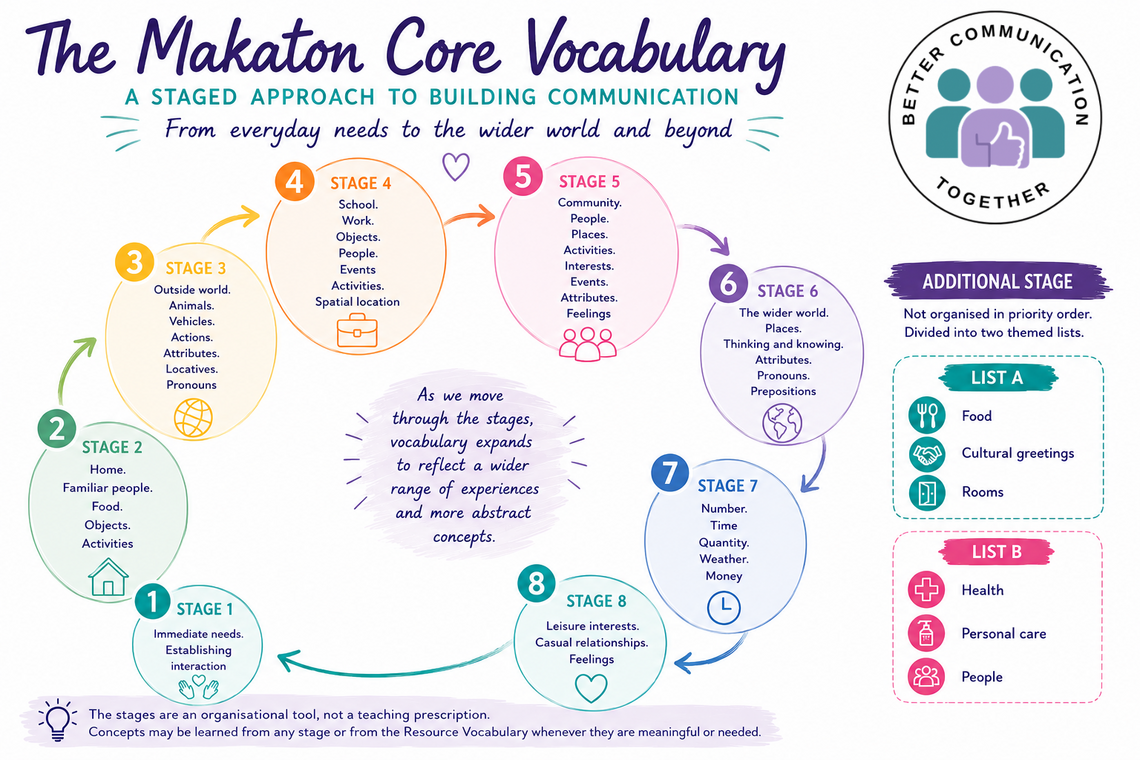
The Core Vocabulary is divided into eight stages. Broadly speaking, the earlier stages focus on immediate needs, familiar people, everyday activities and concrete concepts that many people experience regularly. As the stages progress, the vocabulary reflects an expanding world - school, work, community, relationships, interests and increasingly abstract ideas such as time, quantity and money.
The stages are not a measure of difficulty or importance. They simply provide a structured framework that helps communication develop over time.
When the Core Vocabulary was first revised in 1996, an Additional Stage was introduced.
Unlike Stages 1–8, the Additional Stage is not organised in priority order. Instead, it is divided into two themed lists:
- List A – food, rooms and cultural greetings
- List B – health, personal care and people
Within each list, the concepts are organised by topic and then alphabetically.
It's also important to remember that the stages are an organisational tool, not a teaching prescription. Individuals may learn concepts from different stages—or from the Resource Vocabulary—whenever they are meaningful or needed.
Where did the Core Vocabulary come from?
The Makaton Core Vocabulary didn't appear overnight.
In the early 1970s, speech and language therapist Margaret Walker began researching the language needs of adults with severe communication difficulties. Rather than beginning with a dictionary and deciding which words should be included, Walker observed the concepts people actually needed in order to understand others and express themselves in everyday life. Those observations became the foundation of the Core Vocabulary.
If you'd like to hear the story in Margaret's own words, The Makaton Charity has a wonderful video in which she explains how Makaton first began:
A Brief History of Makaton – Margaret Walker
Since those early days, the Core Vocabulary has been reviewed and refined to reflect changes in language, society and the needs of Makaton users. It is currently undergoing another review, continuing the same process of careful development that began over 50 years ago.
Final thoughts
The Makaton Core Vocabulary isn't about deciding which words are important enough to learn.
It's about identifying the concepts that unlock the greatest number of communication opportunities.
Combined with personalised Resource Vocabulary, it gives people both the flexibility to communicate in everyday situations and the freedom to talk about the things that matter most to them.
It's not about restricting communication.
It's about giving people the strongest possible foundation on which communication can continue to grow throughout life.
One of the biggest misconceptions about Makaton is that the Core Vocabulary is all the vocabulary there is. In reality, it's just the foundation. In my next article, I'll explore the myth that Makaton is "too limited" and explain why the vocabulary is far more extensive than many people realise.
About the author
Nic Pike is Director of Better Communication Together CIC and a Licensed Makaton Tutor and Tutor Training Facilitator. She writes about Makaton, accessible communication and inclusive practice, drawing on over 40 years' professional experience and lived experience as a parent of a Makaton user.
© 2026 Better Communication Together CIC. All rights reserved.
This article is provided for personal learning and information. Please link to this page rather than copying or republishing the content.