
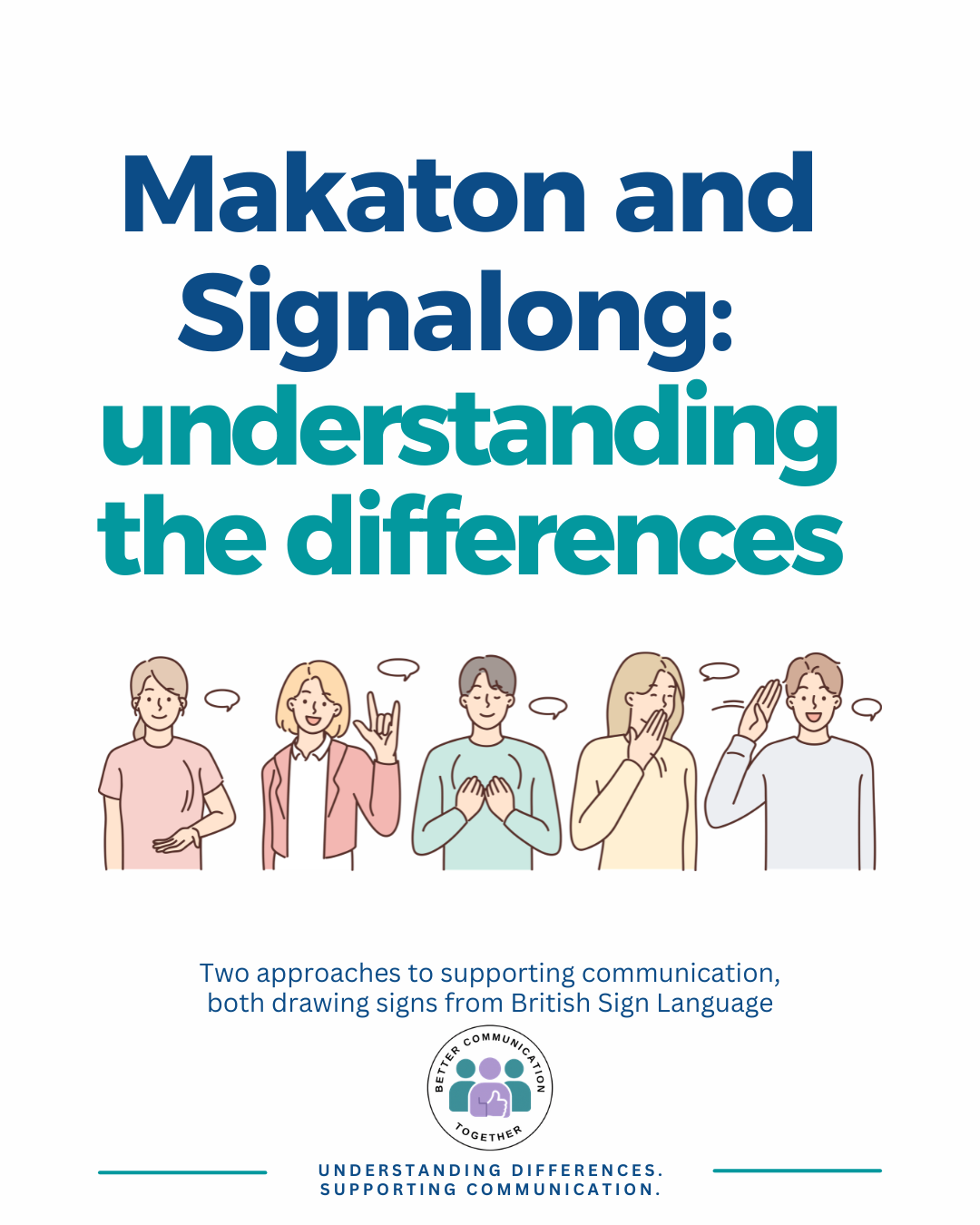
If you’ve been looking into signing to support communication, you may have come across both Makaton and Signalong. Perhaps your child’s school uses one, while another service offers training in the other.
It’s understandable to wonder how they differ. Some signs look the same, and both approaches support communication. But there are differences worth understanding, particularly when someone relies on signs to understand others and express themselves.
I’m writing from my experience as a Makaton tutor and my understanding of Signalong’s published information. This article explores the similarities and differences, and what they mean for the people using signs to communicate.
What do they have in common?
In the UK, both Makaton and Signalong draw signs from British Sign Language (BSL). Both use signs alongside speech, in spoken word order, with facial expression and body language helping to convey meaning.
They are distinct from BSL, which is a language with its own grammar.
Both approaches teach people to look carefully at the components of a sign: the handshape, where it is made, how the hands and fingers are orientated, and how they move.
Signalong places particular emphasis on its consistent written descriptions, helping people reproduce signs accurately and access new vocabulary.
Makaton also teaches these components, referred to as cheremes, and acknowledges the work of sign language linguist William Stokoe. Within Makaton, sign analysis can also help us record a person’s signing, recognise progress and better understand their communication.
Although the way signs are described and presented may differ, attention to their component features is a shared foundation.
How does Makaton work?
Makaton is a communication programme that brings together signs, symbols and speech. It can be used through functional, key word and full grammatical approaches, according to individual need.
A functional approach may use one sign or symbol to convey a whole message. A key word approach highlights the important words within a sentence. A full grammatical approach represents the words and grammatical information more fully.
These are ways of adapting communication to the person, rather than a ladder everyone is expected to climb.
Makaton’s Core Vocabulary provides a structured foundation of useful everyday concepts. A wider Resource Vocabulary provides additional signs and symbols for interests, activities and experiences.
That structure supports learning, while allowing communication to be personalised. Someone’s own priorities and interests still matter.
Symbols are an integral part of Makaton. They provide another way to support understanding and expression, including for people who cannot or prefer not to sign.
How does Signalong work?
Signalong describes itself as a key word signing system used alongside speech. It provides sign vocabulary across a range of topics, with written descriptions and illustrations explaining how to produce the signs.
Its approach allows people to select vocabulary according to need. It also offers training and guidance on using signing to support communication.
Although its stated approach is key word signing, some of its published resources include grammatical vocabulary. Describing it as a key word system should therefore not be taken to mean that its resources contain no grammatical signs.
Signalong focuses on signing. People using it may also use pictures, symbols or other communication support, but that is different from Makaton’s provision of signs and symbols within one programme.
What about “one sign per concept”?
Signalong describes its approach as “one concept per sign, one sign per concept”, contrasting this with other BSL-based systems. That wording can leave readers with the impression that current Makaton does not distinguish between concepts.
There is some history worth understanding here. Early Makaton used the same sign for some distinct concepts, such as BED and SLEEP, or FOOD and EAT. These were separated when the Core Vocabulary was revised.
Those early examples should therefore not be presented as differences between the current approaches.
It is also useful to distinguish a concept from a spoken word. Different words can express a shared meaning, while the same word can have several meanings. When choosing a sign, we need to consider the meaning we want to communicate.
Why does it matter which one you use?
Some signs overlap, but you cannot assume that every sign will be the same in both systems.
If someone learns a sign at school, they need people at home and in other settings to recognise it. Equally, the signs adults model need to connect with the person’s established communication.
That does not mean exposure to different signs automatically causes confusion. It means the people supporting someone need to understand what they already use and work together.
If home and school use different approaches, compare the vocabulary the person actually needs. Identify any differences and agree how everyone will support their communication. A shared record of familiar signs can be useful.
The responsibility for making communication work should be shared by the people supporting the individual.
Familiar communication should travel with the person
I know of adult services choosing Signalong when the schools in their area use Makaton. I would urge services to consider continuity before commissioning training.
Moving into adult services can mean new people, new places and new routines. If someone arrives already understanding and using Makaton, staff need to recognise and support that communication.
Before choosing an approach, services should find out what the people they support already use. Speak with them, their families and the education settings or professionals who know their communication.
The same principle applies whichever approach someone uses. A service’s choice should be informed by the person’s communication, rather than expecting the person to adapt to the service’s choice.
Familiar signs are part of someone’s established way of understanding and expressing themselves. That deserves consideration when planning a transition.
Where should you start?
Check which approach a book, video or course teaches. Familiar-looking signs do not guarantee that all its vocabulary matches the system you use.
Training can help you understand how to use signing in everyday communication, as well as how to produce individual signs.
If you are choosing an approach for a family, school or service, start by finding out what the person already understands and uses. Consider their communication needs, the resources available and how the people around them will learn and maintain their skills.
As a Makaton tutor, I value its combination of signs and symbols and its structured, flexible approach. I also want families and services to understand the differences clearly.
The choice matters because communication happens between people. Whatever approach someone uses, the people around them need to understand it, use it themselves and support them to communicate about the things that matter to them.
About the author
Nic Pike is Director of Better Communication Together CIC and a Licensed Makaton Tutor and Tutor Training Facilitator. She writes about Makaton, accessible communication and inclusive practice, drawing on over 40 years' professional experience and lived experience as a parent of a Makaton user.
© 2026 Better Communication Together CIC. All rights reserved.
This article is provided for personal learning and information. Please link to this page rather than copying or republishing the content.
Tags:
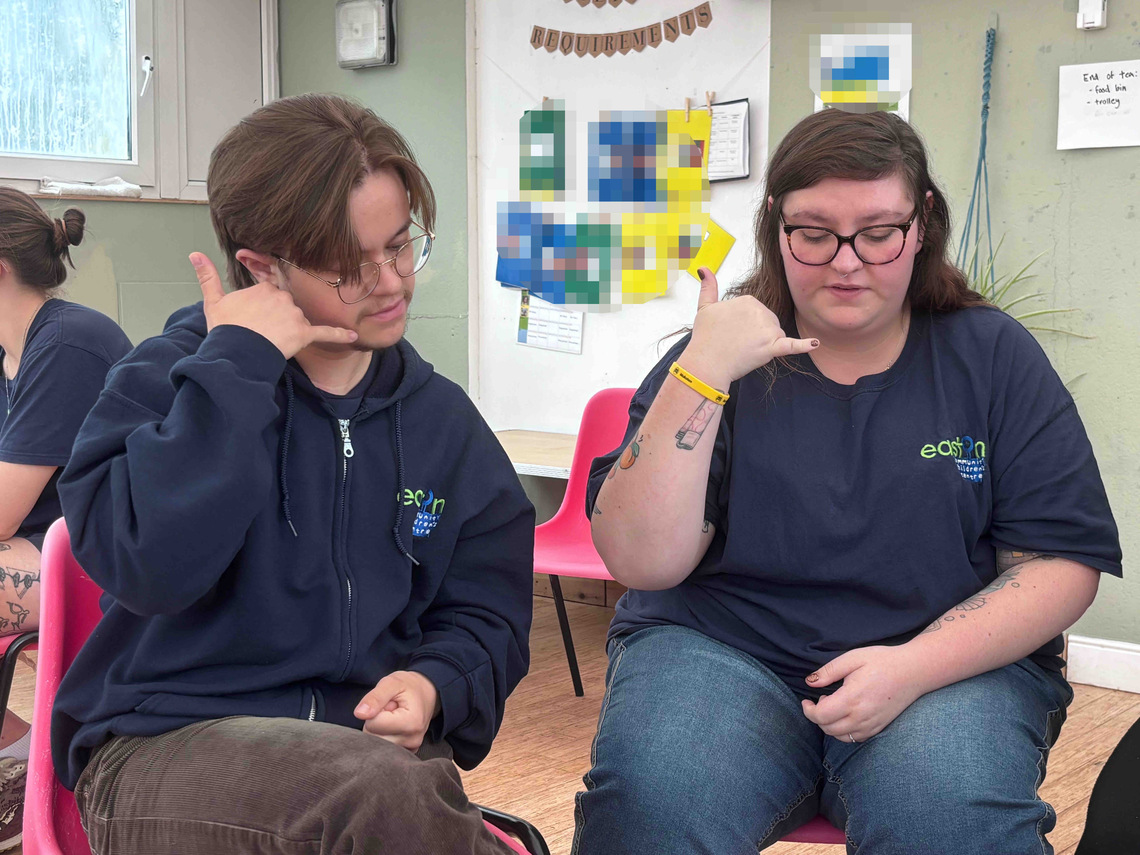
You Know More Makaton Than You Think
Getting More From the Signs You Already Know
When we think about extending someone's vocabulary, it's easy to assume that means learning more and more signs.
But there's another way we can extend communication: by modelling the range of meanings that familiar signs can express.
One sign doesn't always mean one spoken word
Makaton is based around concepts, rather than simply providing a sign for every individual English word.
That's particularly important when we think about the Makaton Core Vocabulary.
The Core Vocabulary is a carefully selected collection of concepts that can be used again and again across lots of different situations. Because those concepts are flexible, knowing one sign may give you more communication possibilities than you realise.
Take HOT.
We might use the concept when we say:
warm
sweltering
roasting
The exact spoken word we choose depends on the situation, but we don't necessarily need to teach a completely different sign each time.
And that gives us a great opportunity for modelling.
Model the sign - but vary the language around it
Rather than always saying exactly the same word when you use a familiar sign, we can naturally model some of the different language associated with that concept.
“The water is warm.”
“Careful - that's hot!”
“Phew! It's boiling today!”
The person sees a familiar sign being used while hearing a wider range of spoken vocabulary.
We're not testing them or expecting them to copy us. We're simply showing them how communication works.
Your face and body communicate too
Signs don't exist in isolation.
Facial expression, body language, movement and emphasis can all help convey meaning.
Think about the difference between calmly commenting that your dinner is warm and pulling your hand away from a really hot plate. The sign may be the same, but there is much more information available to the person watching you.
This is one of the reasons modelling Makaton in real situations is so valuable. Context helps give a sign meaning.
The Makaton Library can help
There's a useful tool for this that people can easily overlook.
When you search the Makaton Library, it doesn't just help you find a sign or symbol. It can also suggest other words and meanings associated with that concept.
I sometimes think of it a little like a Makaton thesaurus.
If you know a sign but aren't sure whether it can also be used for another word you want to say, it's worth looking it up. You may discover that the vocabulary you already know can take you much further than you thought.
This is why Core Vocabulary matters
The aim isn't to collect hundreds of individual signs as quickly as possible.
Core Vocabulary gives us a foundation of useful, flexible concepts. By modelling those concepts repeatedly, in different situations and alongside natural spoken language, we show how they can be used to communicate an increasingly wide range of meanings.
So extending someone's vocabulary doesn't always mean:
“What's the next sign I need to teach?”
Sometimes a better question is:
“What else can we communicate with the signs we already know?”
And that, I think, is one of the cleverest things about the Makaton Core Vocabulary.
About the author
Nic Pike is Director of Better Communication Together CIC and a Licensed Makaton Tutor and Tutor Training Facilitator. She writes about Makaton, accessible communication and inclusive practice, drawing on over 40 years' professional experience and lived experience as a parent of a Makaton user.
© 2026 Better Communication Together CIC. All rights reserved.
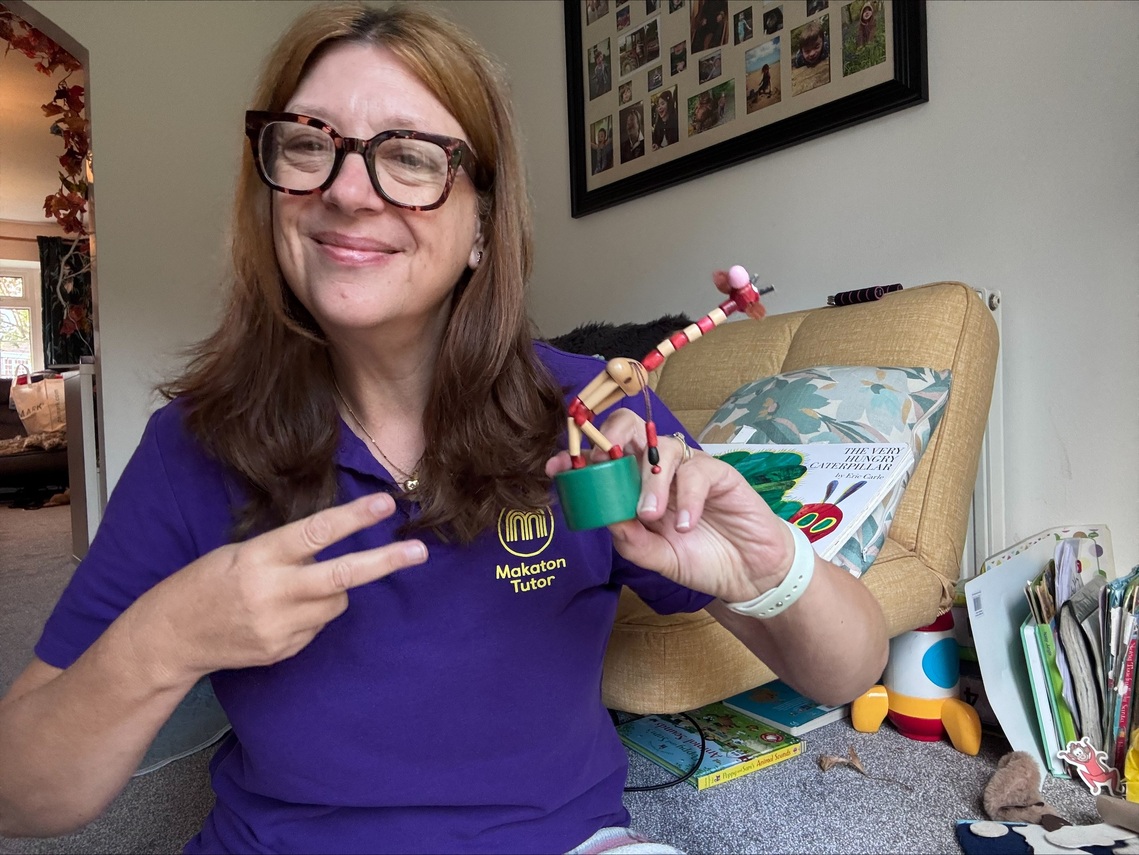
Again, Again! Why Repeating Signs Matters
Getting Started with Makaton
Again, Again! Why Repeating Signs Matters
When people begin using Makaton, they are often keen to keep learning more and more signs.
Learning new signs is exciting, but communication is not about how many signs you know. It is about being able to use the signs you know confidently, naturally and at the right moment.
That is why repeating the same signs is such a good thing.
Repetition helps signs become familiar
Most of us need to see or hear something many times before we remember it. Signs are no different.
When someone sees the same sign used regularly, they have repeated opportunities to:
- notice the sign
- connect it with the spoken word
- understand what it means
- see how it is used
- begin to use it themselves, if they are able to
Someone may understand a sign long before they attempt to make it. They might also use an approximation rather than producing the sign exactly as it has been modelled. Both are important parts of communication development.
Familiar signs are easier to process
Communication can move very quickly. By the time someone has processed one sentence, the conversation may already have moved on.
Using familiar signs can make communication easier to follow. The signs act as visual clues, helping to highlight the important information in what we are saying.
If we are constantly introducing new vocabulary, we may unintentionally increase the processing demands. Repeating familiar signs gives someone more time and more opportunities to make sense of them.
Everyday routines provide natural repetition
Repetition does not need to mean sitting down for a formal practice session or asking someone to copy a sign over and over again.
The most useful repetition often happens naturally during everyday life.
For example, the sign for drink might be used when:
- offering a drink
- asking what someone would like
- preparing a drink together
- noticing that a cup is empty
- talking about what someone has had
- choosing between two drinks
The sign stays the same, but it is used in different, meaningful situations.
Words such as more, finished, help, toilet, eat, drink, good, where? and what? can appear many times throughout the day. These everyday signs may be much more useful than a large collection of signs that are rarely used.
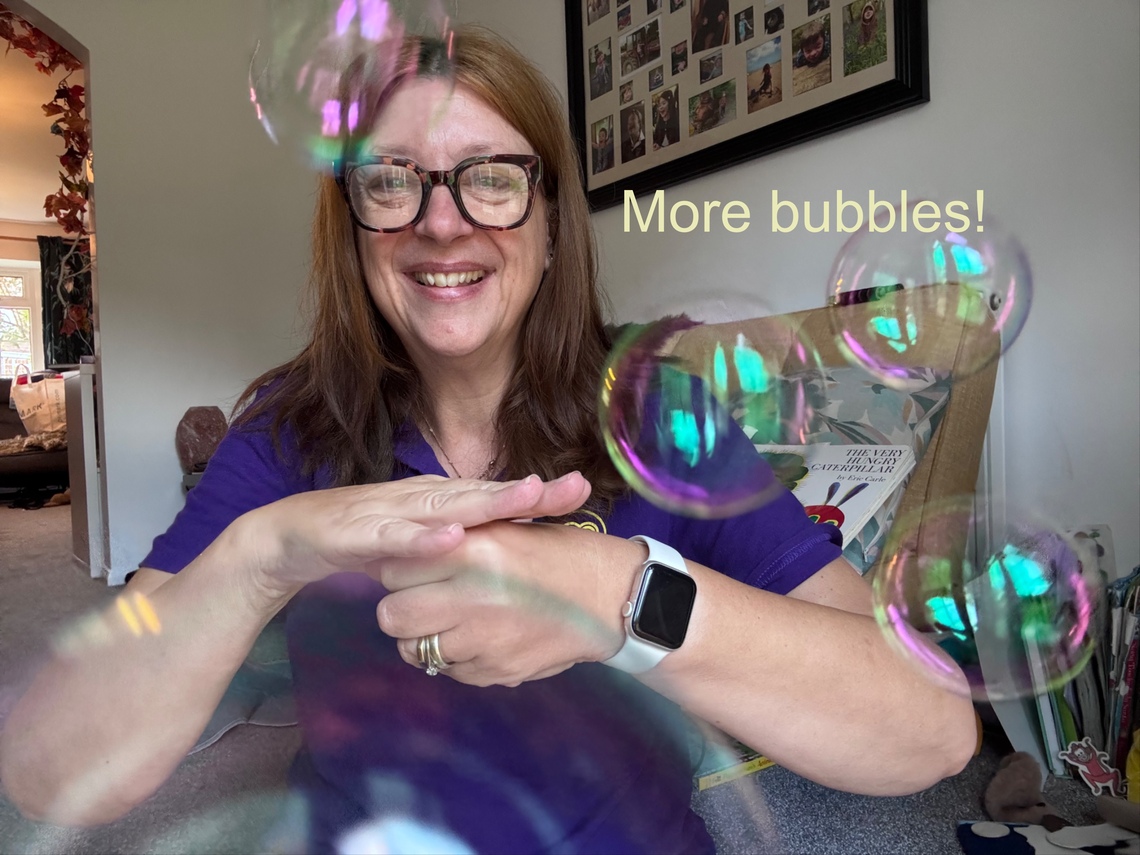
Repetition builds confidence
It can be tempting to stop using a sign because the person has not yet signed it back. But not seeing an immediate response does not mean the sign has not been noticed or understood.
Keep modelling it without pressure.
People need time to become familiar with a sign and to understand that it has a useful purpose. They also need to know that their communication attempts will be noticed and responded to.
Seeing the same signs used consistently by the people around them can help build that confidence.
You do not have to sign every word
Speak naturally and add signs to the most important words in your sentence. Keep your language clear, allow plenty of processing time and give the person an opportunity to respond in their own way.
That response might be a sign, a word, a sound, a facial expression, a movement, an object, a symbol or a change in body language. Communication is much bigger than speech or signing alone.
Familiar does not mean boring
We often worry that repeating vocabulary will become boring. In reality, familiar signs can be used in lots of different ways - during songs, stories, games, choices, conversations and daily routines.
You can add new vocabulary gradually, but there is no need to rush. A small number of useful signs, modelled frequently and meaningfully, can make a much bigger difference than dozens of signs that are learned once and then forgotten.
So if you feel as though you are using the same signs again and again, you are probably doing something very helpful.
Repetition creates familiarity. Familiarity supports understanding. And understanding gives communication the best chance to grow.
About the author
Nic Pike is Director of Better Communication Together CIC and a Licensed Makaton Tutor and Tutor Training Facilitator. She writes about Makaton, accessible communication and inclusive practice, drawing on over 40 years' professional experience and lived experience as a parent of a Makaton user.
© 2026 Better Communication Together CIC. All rights reserved.
This article is provided for personal learning and information. Please link to this page rather than copying or republishing the content.
Tags: