
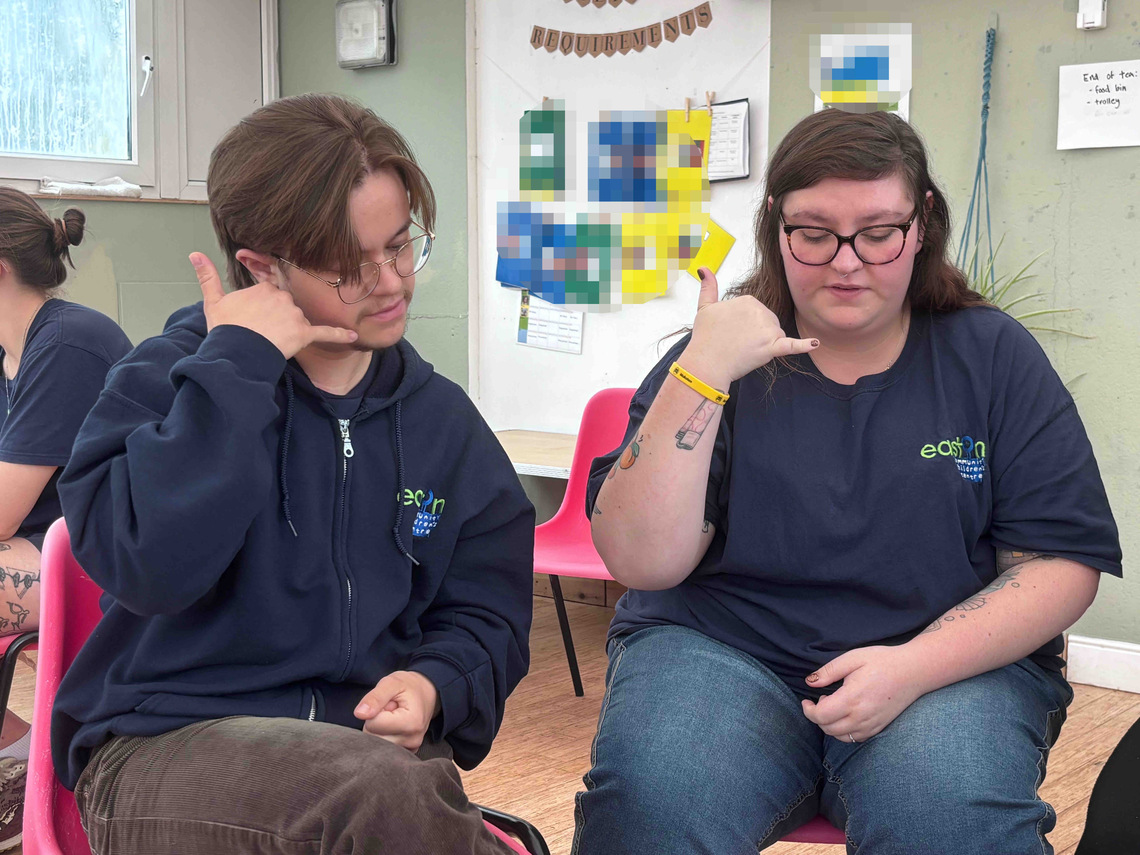
When we think about extending someone's vocabulary, it's easy to assume that means learning more and more signs.
But there's another way we can extend communication: by modelling the range of meanings that familiar signs can express.
One sign doesn't always mean one spoken word
Makaton is based around concepts, rather than simply providing a sign for every individual English word.
That's particularly important when we think about the Makaton Core Vocabulary.
The Core Vocabulary is a carefully selected collection of concepts that can be used again and again across lots of different situations. Because those concepts are flexible, knowing one sign may give you more communication possibilities than you realise.
Take HOT.
We might use the concept when we say:
warm
sweltering
roasting
The exact spoken word we choose depends on the situation, but we don't necessarily need to teach a completely different sign each time.
And that gives us a great opportunity for modelling.
Model the sign - but vary the language around it
Rather than always saying exactly the same word when you use a familiar sign, we can naturally model some of the different language associated with that concept.
“The water is warm.”
“Careful - that's hot!”
“Phew! It's boiling today!”
The person sees a familiar sign being used while hearing a wider range of spoken vocabulary.
We're not testing them or expecting them to copy us. We're simply showing them how communication works.
Your face and body communicate too
Signs don't exist in isolation.
Facial expression, body language, movement and emphasis can all help convey meaning.
Think about the difference between calmly commenting that your dinner is warm and pulling your hand away from a really hot plate. The sign may be the same, but there is much more information available to the person watching you.
This is one of the reasons modelling Makaton in real situations is so valuable. Context helps give a sign meaning.
The Makaton Library can help
There's a useful tool for this that people can easily overlook.
When you search the Makaton Library, it doesn't just help you find a sign or symbol. It can also suggest other words and meanings associated with that concept.
I sometimes think of it a little like a Makaton thesaurus.
If you know a sign but aren't sure whether it can also be used for another word you want to say, it's worth looking it up. You may discover that the vocabulary you already know can take you much further than you thought.
This is why Core Vocabulary matters
The aim isn't to collect hundreds of individual signs as quickly as possible.
Core Vocabulary gives us a foundation of useful, flexible concepts. By modelling those concepts repeatedly, in different situations and alongside natural spoken language, we show how they can be used to communicate an increasingly wide range of meanings.
So extending someone's vocabulary doesn't always mean:
“What's the next sign I need to teach?”
Sometimes a better question is:
“What else can we communicate with the signs we already know?”
And that, I think, is one of the cleverest things about the Makaton Core Vocabulary.
About the author
Nic Pike is Director of Better Communication Together CIC and a Licensed Makaton Tutor and Tutor Training Facilitator. She writes about Makaton, accessible communication and inclusive practice, drawing on over 40 years' professional experience and lived experience as a parent of a Makaton user.
© 2026 Better Communication Together CIC. All rights reserved.