
What is a symbol? More than just a picture
We all use symbols every day. We just don’t always recognise them as symbols.
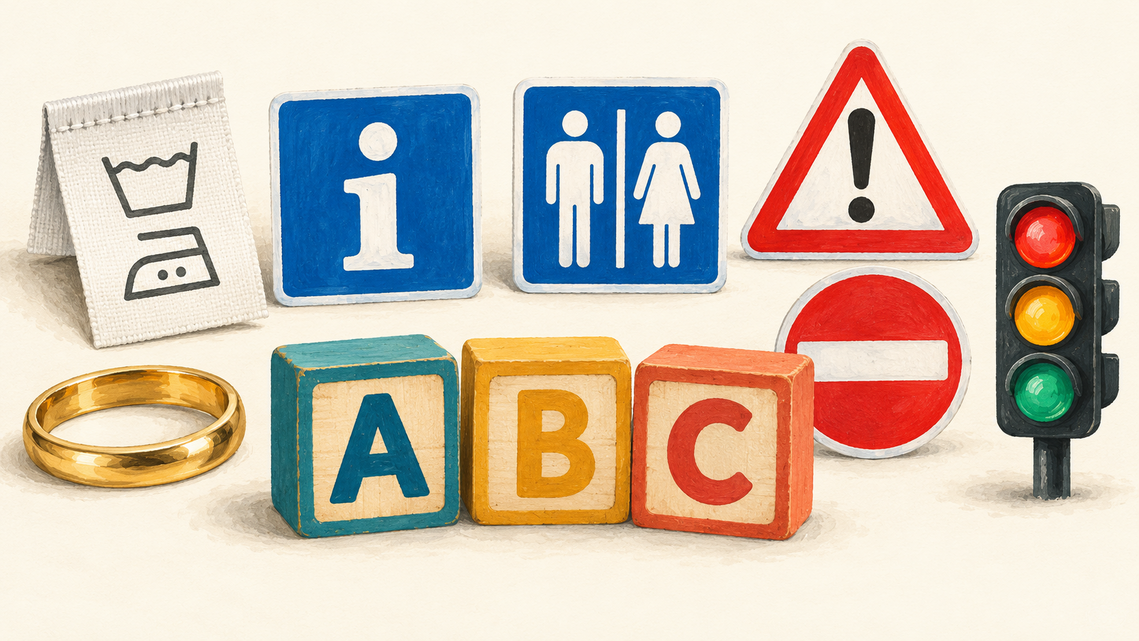
Have you ever checked a clothing label before putting something in the washing machine? Looked for the toilets in an unfamiliar building? Followed signs through an airport or checked a menu for vegetarian options?
Then you have used symbols to help you understand information and decide what to do.
Yet when we talk about symbols in communication, people often think of little pictures on cards, perhaps used in a school or on a visual timetable.
Those are examples of symbols. But the idea of a symbol is much bigger than that.
Symbols are all around us
Think about how many symbols you might encounter in an ordinary day.
The laundry symbols that tell you whether you can tumble-dry your clothes. The battery symbol on your phone. A musical note, a shopping basket or a magnifying glass on a website.
Away from home, we use symbols to find toilets, lifts and parking spaces. Hospitals and airports use them to help us find our way. Menus may use a leaf, a chilli or other symbols, explained in a key, to tell us about the food.
On the road, we don’t just get information from the picture or words on a road sign. Its shape and colour help us understand its message too.
In the Highway Code, triangular signs generally warn us about something ahead. Circular signs give orders: red circles usually tell us what we must not do, while blue circles usually tell us what we must do. Rectangular signs generally provide information or directions.
Colour adds another layer of meaning. Blue motorway direction signs, green direction signs on primary routes and brown signs for tourist attractions help us recognise the kind of information we are looking at.
We learn these patterns, and they help us make sense of road signs quickly. We might recognise that a sign is giving us a warning before we have worked out exactly what it is warning us about.
I often use the Highway Code as a comparison when exploring the design themes of Makaton symbols in training. Recognising recurring features can give us clues about meaning and help us make connections between symbols.
There is more to a symbol than the individual picture. The way it is designed can carry information too. We don’t usually think of ourselves as needing “symbol support” when we follow an airport sign. We are simply using information presented in a way we recognise.
So, what makes something a symbol?
A symbol is something that stands for or represents something else.
It might represent an object, an action, a feeling, an instruction or an idea. It doesn’t have to be a picture, and it doesn’t have to look like what it represents.
A wedding ring is a good example.
Physically, it is a piece of jewellery. But it can also represent marriage, commitment and a relationship. Its meaning goes beyond the object itself.
A heart shape can represent love. A flag can represent a country or community. A particular piece of music might become symbolic of an important occasion in someone’s life.
Some meanings are widely shared. Others are cultural or deeply personal. The same object can mean different things to different people.
We learn what symbols mean
Some symbols give us a visual clue. A drawing of a bicycle resembles the thing it represents.
Other connections are less obvious. There is nothing about a heart shape that automatically tells us it means love. We learn that association through seeing how it is used.
Even familiar everyday symbols can leave us puzzled. Most of us have encountered a laundry symbol or a dashboard warning light that we needed to look up!
Once we know a symbol well, understanding it can feel effortless. It is easy to forget that its meaning wasn’t always familiar to us.
That matters when we support someone else’s communication. What seems obvious to us may still be unfamiliar to them.
Words are symbols too
This is where we can widen our thinking further.
Spoken words and written words are also symbolic. Language uses symbols to represent meaning, whether expressed through speech, writing or a signed language.
Think about the word tree.
The written word doesn’t look like a tree. The spoken word doesn’t sound like leaves rustling or branches moving. We have learned that this particular arrangement of letters, and this particular sequence of speech sounds, represent that concept.
Someone using another language may use a different word for the same thing.
The connection feels natural because we know it so well. But the word and the thing it represents are separate.
The alphabet: a small set with enormous possibilities
For those of us who read and write English, the alphabet is an extraordinarily flexible set of symbols.
Just 26 letters can be combined and rearranged to write thousands of words. Those words can then be combined into messages, questions, stories, explanations and ideas.
Letters generally represent speech sounds, individually or in groups. Together, they form written words that carry meaning.
We can write about something in front of us, something that happened years ago or something that exists only in our imagination. We can create a sentence that nobody has ever written before.
The same small collection of symbols allows us to write a shopping list, a love letter, a complaint or a novel.
But that flexibility becomes available through learning. Seeing the letters is not the same as knowing how to read them. A page written in an unfamiliar writing system can remind us how much understanding depends on knowing the code.
Where do Makaton symbols fit?
When we talk about symbols within Makaton, we usually mean graphic symbols: visual representations of concepts that can support understanding and expression. Makaton combines these with signs and speech.
Graphic symbols are one form of symbolic communication within this much wider picture.
They can help represent objects, actions, feelings and ideas. Like other symbols, their meaning needs to become familiar through meaningful use.
We can support that by using symbols ourselves: pointing to them as we speak, connecting them with everyday experiences and responding when someone uses them to tell us something.
Their value extends beyond showing someone what will happen next. They can also give someone ways to ask, comment, disagree, share a feeling or have their say.
The next time you check a clothing label, follow an airport sign or read a message on your phone, take a moment to notice the symbols involved.
Symbols are already woven through our everyday lives. Recognising that can help us better understand the different ways other people communicate.
About the author
Nic Pike is Director of Better Communication Together CIC and a Licensed Makaton Tutor and Tutor Training Facilitator. She writes about Makaton, accessible communication and inclusive practice, drawing on over 40 years' professional experience and lived experience as a parent of a Makaton user.
© 2026 Better Communication Together CIC. All rights reserved.
This article is provided for personal learning and information. Please link to this page rather than copying or republishing the content.
Makaton, Makaton symbols, visual supports, visual timetables, communication, inclusive communication