
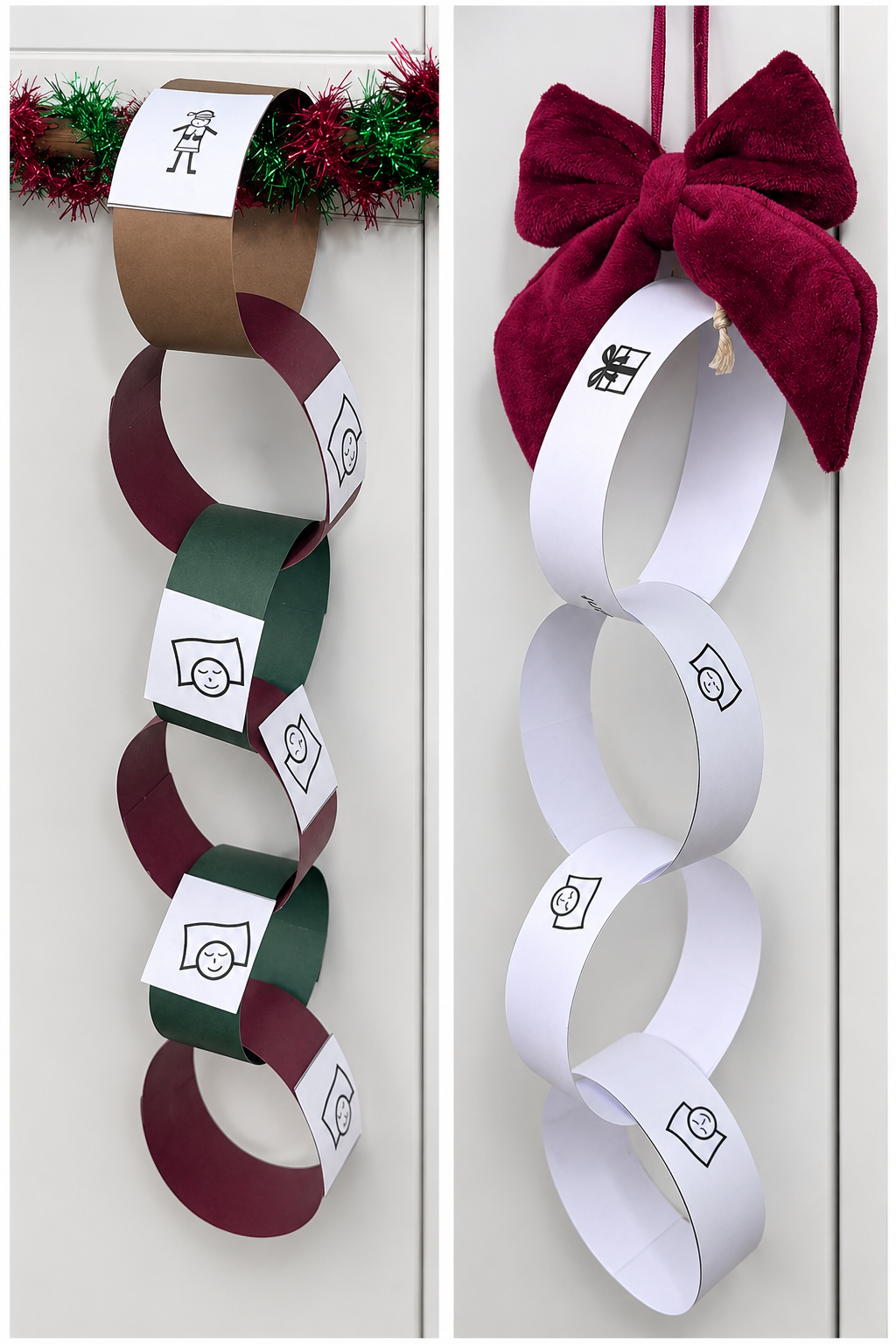
“How many sleeps until Christmas?”
Waiting can be difficult. We might explain that something is happening “next Friday” or “in two weeks”, but those phrases depend on quite an abstract understanding of time.
A calendar can help some people follow what is coming. For others, the dates and boxes may not mean very much yet. We may need another way to show what we mean.
This simple paper chain makes the wait visible. Each link represents one sleep. As the sleeps pass, we remove the links, and the chain gets shorter.
Something we can see and touch
Paper chains are a familiar Christmas decoration, but adding a purpose gives us another way to use them.
There is something physical to hold, explore and change. Someone can help remove a link, feel the paper or watch the chain getting shorter. We have an action to use alongside our spoken words, signs and symbols.
That action still needs meaning, though. Taking a paper link off a chain doesn’t automatically explain the passing of time. We build the connection through using it together: one sleep has happened, so one link comes off. There are fewer sleeps left until the event.
The chain also hangs in one simple line, making it easier to see where to start and what comes next. Some advent calendars have numbered doors dotted around in a mixed-up order. Finding the right door adds another task, which may make the countdown harder for some people to follow.
The lovely Makaton advent calendar, available from The Makaton Charity’s shop, has its doors in order, giving a clear sequence to follow too.
Why “sleeps”?
I’ve used sleeps because going to bed and waking up are familiar experiences that we can connect the countdown to.
The sleep symbol gives us something to refer to alongside the sign and spoken word. But, as with any symbol, we need to establish what it means to the individual. Having a symbol printed on a strip of paper doesn’t automatically make its meaning clear.
Using it during familiar bedtime and waking routines can help build that connection. If sleeps aren’t a helpful reference for someone, we can adapt the countdown around another familiar daily routine.
Make it personal
The Christmas version counts down to Christmas, but the generic version can be used for another event that matters to the person. That could be a birthday, a holiday, going back to school or a visit from somebody special.
Choose a picture that helps the person recognise what is coming. A photograph of the actual person, place or activity may be more meaningful than a general picture.
Think about how much notice is helpful, too. Two or three sleeps might be a useful starting point. Some people enjoy following a longer countdown. Others may find the wait harder if we keep drawing attention to something that still feels a long way away.
There’s no requirement to make a whole month’s countdown just because we can!
And the event doesn’t have to be something the person is excited about. They might feel worried, uncertain or a mixture of feelings. The chain gives us something to refer to when talking about what is coming, whatever those feelings might be.
Make it together
Making the chain offers opportunities for choices, communication and participation.
Someone might enjoy cutting the strips and assembling the whole thing. Someone else might choose the paper, pass over a strip, hold a loop or help stick the ends together.
Choices can be made through looking, pointing, signing, speech or a communication aid. We can prepare the strips beforehand and support the fiddly parts.
The aim is meaningful involvement. That will look different for each person.
One link at a time
Choose a consistent point in the day to use the chain. For example, after waking up, remove one link because that sleep has now happened.
Alongside signs for the key words, you might say:
“Sleep finished. Take one off. Three more sleeps until Christmas.”
Then pause. Allow time for the person to look, respond or take part.
You can count the remaining links together if that is useful, but it doesn’t need to become a test. Someone can notice the chain getting shorter without independently counting every link.
Keep the event picture visible and make sure everyone supporting the person knows the routine, so a link isn’t accidentally removed twice. Someone may prefer to watch or direct another person to remove it. They don’t have to handle the paper to be involved.
When the final sleep link comes off, we reach the event picture:
“Today is Christmas!”
That final connection matters. We can show that the waiting has finished and the event is happening.
For something such as a holiday or a return to school, the person may also need photographs, objects or a visual timetable to help explain what will happen when they get there. The chain shows the wait; those other supports can help explain the event itself.
Exploring time in other ways
Picture books give us opportunities to talk about time, too. My own book, Christmas Time, can be used to look at what is happening in the pictures and explore concepts such as before and after.
We might look at the tree before it is decorated, then look at it after the decorations have been added. What has changed? What happened first? What happens next?
These conversations connect time words with something we can see and discuss together. We can make similar connections during everyday activities: before and after getting dressed, making lunch or going out.
There’s no single way to make time meaningful for everybody. We can start with a familiar routine, an event that matters to the person and a way of showing the wait that works for them. Then we can take it one sleep at a time.
About the author
Nic Pike is Director of Better Communication Together CIC and a Licensed Makaton Tutor and Tutor Training Facilitator. She writes about Makaton, accessible communication and inclusive practice, drawing on over 40 years' professional experience and lived experience as a parent of a Makaton user.
© 2026 Better Communication Together CIC. All rights reserved.
This article is provided for personal learning and information. Please link to this page rather than copying or republishing the content