
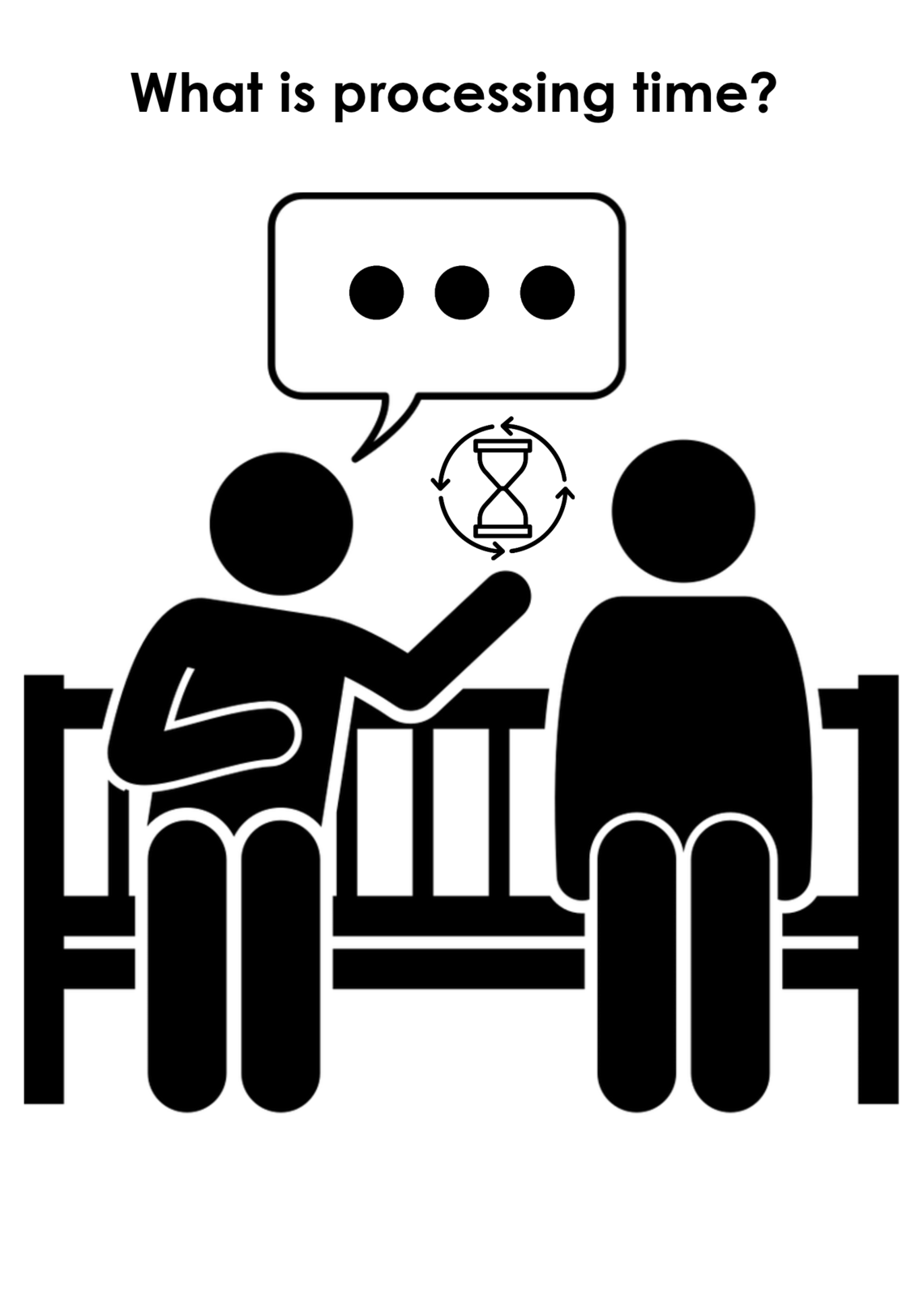
What is processing time There’s more happening in the pause
Sometimes someone says something to me and I hear it - but I don’t do anything with it straight away. My mind is already busy with something else. The words seem to sit there for a moment, waiting for me to turn my attention to them.
Then I catch up. I might even say “What?” and start answering before the person has had a chance to repeat themselves.
Other times, I’ve taken in part of what was said and need to hear the same words again. My husband will often rephrase or explain straight away, trying to help. But I’m still processing the first sentence, and now there’s another one to make sense of.
Perhaps I need to say “Give me a moment” or “Can you say the same words again?” But “What?” can be automatic. It helps if the person I’m talking with understands that I might need a pause before anything else.
That is my experience. For someone with a learning disability, processing may feel very different, and the support they need may be different too. Someone may need more time to understand a message, support to make its meaning accessible, time to work out their response, or a combination of these. They may not have an easy way to tell us what they need.
My experience reminds me how easily we can move a conversation on before someone is ready. It doesn’t tell me exactly what is happening for another person.
What do we mean by processing time?
In everyday communication, we often use “processing time” to describe the time someone needs to take in and make sense of a message.
But the pause before a response can involve more than understanding. A person may be shifting their attention, connecting the message to the situation, considering their answer or finding a way to express it.
They might be preparing a sign, finding a symbol in a communication book, putting words together or using a communication device. These demands can overlap. They are not a fixed sequence that everyone follows.
We cannot measure someone’s understanding simply by how quickly they respond. And silence, on its own, does not tell us whether someone has understood, is still thinking, needs different support or does not want to answer.
What does research tell us?
Research suggests that allowing more time can create opportunities for communication.
In a small study published in 2013, Johnson and Parker worked with three children with visual impairments and additional disabilities, including one deafblind child. They compared prompting almost immediately with waiting for 5, 10 or 15 seconds. All three children responded around twice as often during the intervention phases.
That is encouraging, but it was a very small study with a particular group of children. It does not establish how long every person with a learning disability needs. journals.sagepub.com
A 2023 study by Sun and colleagues examined response times in young children with complex communication needs who used AAC. It found considerable variation between individuals. The type of communication opportunity mattered too, and modelling AAC was associated with shorter response times. journals.sagepub.com
Together, these findings support paying attention to both the time we allow and the way we support communication. They do not give us a universal countdown.
Should we count to ten?
You may have heard advice to wait ten seconds after asking a question.
Counting silently can be a useful reminder to pause. Alder Hey’s speech and language guidance suggests counting to ten to allow a young person time to plan a response. www.alderhey.nhs.uk
But ten seconds should not become a deadline. Some people may respond sooner; others may need longer. The research described above does not establish one correct waiting time for everyone.
The purpose of counting is to help us leave space. We still need to notice the person and learn what works for them.
Repeating and rephrasing are different kinds of help
When someone does not respond straight away, it is tempting to ask again, explain, offer suggestions or change the question.
“Would you like a drink?”
“Are you thirsty?”
“Shall I get you some water?”
Each sentence may be intended to help. But we have introduced several messages without leaving much room for a response.
Alder Hey’s guidance specifically advises that repeating or rephrasing too quickly can interfere with processing. If repetition is needed, it recommends using the same words first, then changing the wording if the young person still appears not to understand. www.alderhey.nhs.uk
This is not a rule to keep repeating words that are inaccessible. If the meaning is unclear, we may need to simplify the message or support it differently.
The useful distinction is this: needing more time, needing to hear something again and needing a different explanation are not necessarily the same thing.
Time and accessible communication belong together
Waiting alone will not make an inaccessible message understandable.
For someone with a learning disability, support might include familiar words, shorter sentences, Makaton signs, symbols, photographs, objects or demonstration. The right combination will depend on the person and the situation.
NHS England’s guidance for supporting capacity assessments with adults with a learning disability recommends allowing extra time, adapting language and using communication supports where appropriate. www.england.nhs.uk
This matters in everyday conversations too. We need to think about what we communicate, how we communicate it and the space we leave afterwards.
What can we do in practice?
- Help the person attend to the message. Check that they know you are communicating with them. Reduce competing noise or activity where possible. Attention does not have to mean eye contact.
- Make the message manageable. Use familiar language and avoid piling several questions or instructions together.
- Use the support that helps that person. Signs, symbols, objects and other resources can be part of the original message.
- Pause and stay available. Give the person room without filling every silence or repeatedly prompting them.
- Allow time for their response. Keep their communication book or device within reach and leave space for signs, sounds, movements and other ways of communicating.
- Adapt when needed. If waiting is not helping, consider whether the message, environment or communication support needs to change.
- Learn together. Ask the person what helps where possible. Share useful observations with the people who support them, while staying open to differences between situations.
These are starting points, not a script. A pause should create an opportunity to communicate, including an opportunity to decline or say “I don’t know”.
Leaving room
I know how frustrating it can feel when a conversation moves on while I am still catching up.
That experience reminds me to pause, but also to be curious about what someone else needs. Their experience may be very different from mine.
We cannot see everything happening during a pause. Our job is to leave room for a response while making sure the person has the support they need to understand and communicate.
Sometimes that means waiting a little longer. Sometimes it means changing how we communicate. Often, it means doing both.
About the author
Nic Pike is Director of Better Communication Together CIC and a Licensed Makaton Tutor and Tutor Training Facilitator. She writes about Makaton, accessible communication and inclusive practice, drawing on over 40 years' professional experience and lived experience as a parent of a Makaton user.
© 2026 Better Communication Together CIC. All rights reserved.
This article is provided for personal learning and information. Please link to this page rather than copying or republishing the content.